In our previous articles, we looked at how Google AI Overviews choose which content to show and explored why a #1 ranking no longer guarantees visibility in AI search.
Both raised the same underlying question: if rankings aren’t the deciding factor anymore, how do you actually know if your content is “AI-ready”?
This is where most teams get stuck. They understand the concept, but have no structured way to evaluate their own pages against it.
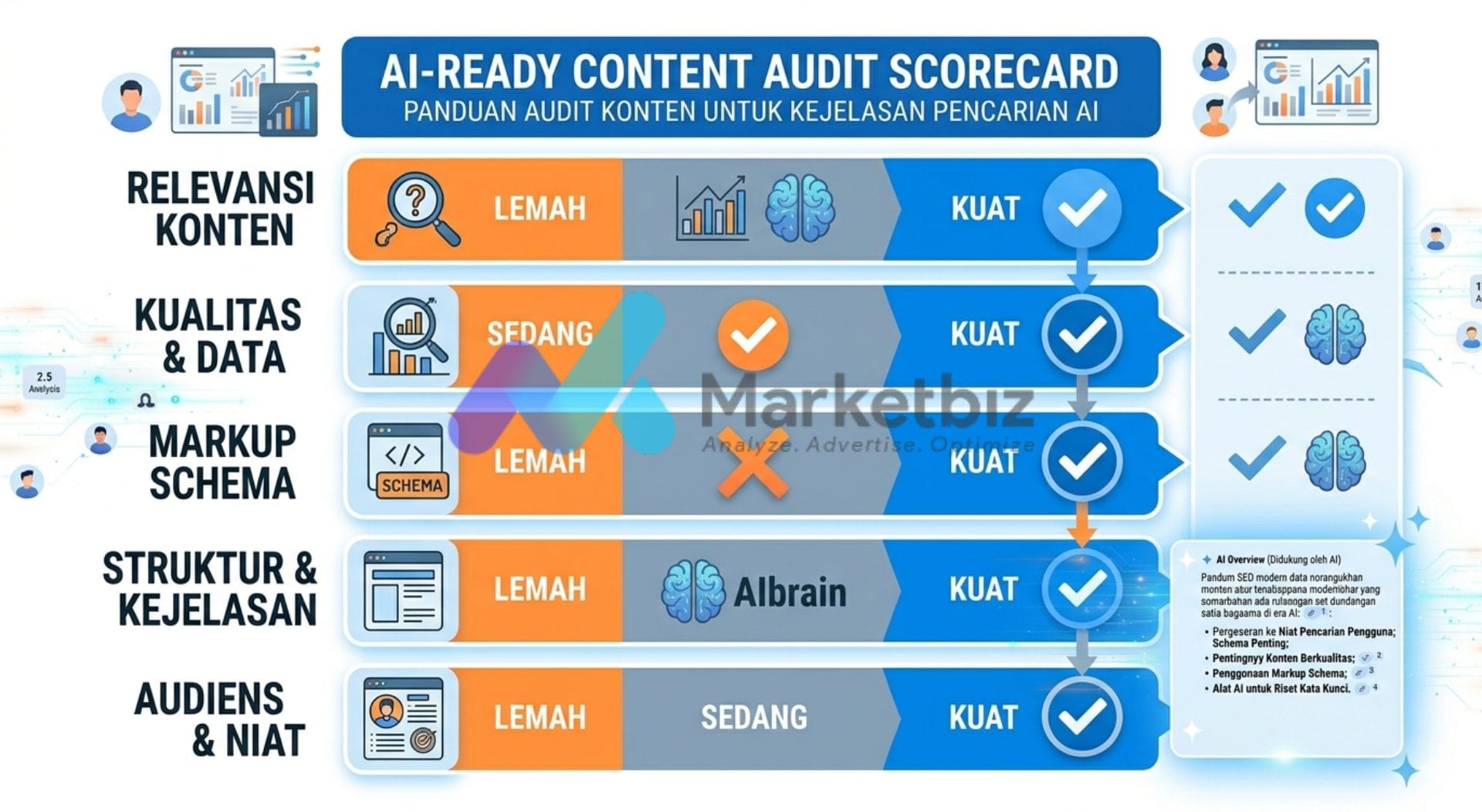
So instead of more theory, here’s the framework we use internally when auditing a client’s content for AI search readiness, five dimensions, each scored independently.
Why a Framework Instead of a Checklist
A simple checklist tends to produce false confidence. A page can tick every box headings present, lists used, keyword included, and still fail to get picked up by an AI Overview.
The reason is that AI systems don’t evaluate elements in isolation. They evaluate how well those elements work together to produce something extractable.
A framework forces that combined view. Each dimension below interacts with the others, and a weak score in one area can undermine strong scores elsewhere.
Dimension 1: Answer Proximity
What it measures: How close the direct answer sits to the question it’s answering.
Many pages bury their core answer several paragraphs deep, after introductions, definitions, and context-setting. AI systems generally don’t reward this pattern, they extract whatever appears closest to the implied question.
How to score it:
- Strong: The answer appears within the first 1–2 sentences of the relevant section
- Moderate: The answer is present but requires reading through 2–3 sentences of setup
- Weak: The answer is implied or scattered across multiple paragraphs
A quick test: pick five H2 headings on a page, written as questions. If you can’t find a direct answer within the first sentence below each one, that section scores weak.
Dimension 2: Structural Clarity
What it measures: Whether the page’s heading hierarchy reflects a logical map of its content.
This goes beyond “does the page have headings.” It’s about whether someone scanning only the headings would understand the full argument of the piece — and whether each heading sets up a section that delivers on it.
How to score it:
- Strong: Headings are specific, sequential, and each one could stand alone as a mini-answer
- Moderate: Headings exist but are generic (“Overview,” “More Information,” “Conclusion”)
- Weak: Headings are inconsistent, missing, or don’t match the content beneath them
Pages scoring weak here often have good information buried under poor signposting, which makes the content harder for AI systems to isolate and reuse.
Dimension 3: Extractable Units
What it measures: How much of the page content exists in self-contained, reusable chunks: definitions, short lists, comparison points, step sequences.
AI Overviews tend to favor content that can be lifted as a unit without needing surrounding context to make sense.
How to score it:
- Strong: Most sections contain at least one extractable unit (a definition, a 3–5 item list, a clear comparison)
- Moderate: Some sections have extractable units, but they’re inconsistent across the page
- Weak: Information is mostly delivered in long, narrative paragraphs with no isolated units
A useful exercise: highlight every sentence on the page that could be copy-pasted as a standalone answer to a likely search query. If highlights are sparse, the extractable-unit score is weak.
Dimension 4: Topical Depth
What it measures: Whether the page sits within a broader cluster of content on the same subject, or stands alone.
This dimension looks beyond the page itself to the site’s overall coverage of the topic. A single well-written article carries less weight than the same article supported by related pieces that explore adjacent angles.
How to score it:
- Strong: The page links to and from multiple related articles covering different angles of the same core topic
- Moderate: Some related content exists, but connections between pages are weak or missing
- Weak: The page exists in isolation with no supporting content on the same topic
This is the dimension where individual page edits matter least and content strategy matters most.
Dimension 5: Redundancy Reduction
What it measures: How much of the page content repeats information already stated elsewhere, versus adding distinct value.
Longer isn’t better. Pages padded with repeated points, restated introductions, or filler transitions dilute the density of useful information, and AI systems tend to favor content with higher information density per section.
How to score it:
- Strong: Each section adds new information; little to no repetition across paragraphs
- Moderate: Some sections restate earlier points with minor variation
- Weak: Significant repetition; the page could be shortened by 30%+ without losing substance
A simple test: read only the first and last sentence of each paragraph. If the page still makes sense, the middle likely contains redundancy.
Putting the Framework Together
Score each dimension as Strong, Moderate, or Weak, then look at the pattern rather than the average.
A page with four Strong scores and one Weak score isn’t “80% AI-ready. The weak dimension often becomes the bottleneck. A page with poor Answer Proximity, for example, can have excellent structure and topical depth and still fail to surface in an AI Overview, because the core answer is never where it needs to be.
This is why audits matter more than isolated fixes. Improving one dimension in isolation rarely moves the needle; the dimensions need to align.
Running This Audit on Your Own Content
Start with your three highest-traffic pages. For each one, score all five dimensions honestly most teams find at least one page scores Weak on two or more dimensions without realizing it.
The pattern that emerges across your top pages usually points to a single underlying issue often Answer Proximity or Structural Clarity that, once addressed, has a multiplier effect across the rest of the site.
If you’d like our team to run this audit on your website and walk through the results together, get in touch with us and we’ll start with a clear picture of where your content stands today.