Your website is live.
It’s indexed on Google.
You may have optimized titles, published content, and even worked on backlinks.
Yet your site still isn’t being prioritized.
No consistent rankings.
No steady traffic.
No meaningful leads.
If you’re wondering why Google isn’t prioritizing your website, the answer is usually not a penalty or a sudden algorithm change.
More often, it’s because your website hasn’t clearly earned that priority yet.
The Biggest SEO Misconception Most Businesses Still Believe
One of the most common assumptions in SEO is that visibility comes from completing a checklist.
Meta titles? Done.
Keywords added? Done.
Technical issues fixed? Done.
The problem is Google doesn’t reward effort.
It rewards usefulness and clarity.
If two websites are technically “optimized,” Google will prioritize the one that better satisfies user intent, demonstrates authority, and feels trustworthy.
This is why many business owners keep asking, “Why is Google not ranking my website even though everything looks right?”
What Google Actually Prioritizes Today
Google’s ranking systems focus less on isolated optimizations and more on overall value.
First, search intent matters more than keywords. Pages that do not clearly match what users are looking for tend to lose visibility, even if they are well written.
Second, Google evaluates topical authority. A single optimized page is rarely enough. Google looks for consistent coverage, supporting content, and clear topical focus across a website.
Finally, trust and clarity are critical. If visitors cannot quickly understand what your business does, who it serves, and why it is credible, Google is unlikely to prioritize the site.
What’s Missing From Most Websites
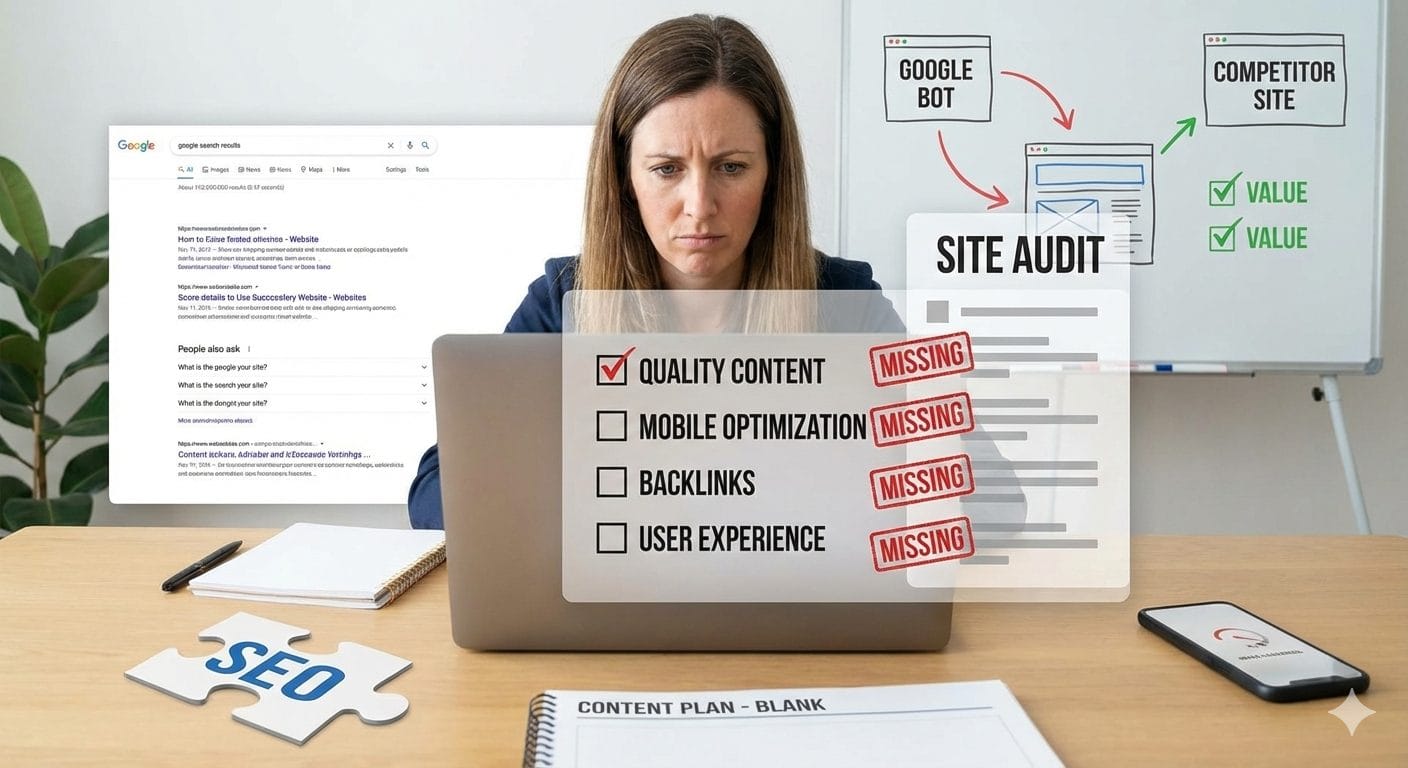
Most SEO problems are not caused by broken elements, but by missing ones.
Many pages target keywords without fully answering the real question behind the search. This results in low engagement and stagnant rankings.
Authority is also often weak. Publishing content without a clear topical structure makes it difficult for Google to recognize your website as an expert source.
Additionally, generic messaging erodes trust. When a website feels interchangeable with competitors, users disengage, and Google notices.
Lastly, much content exists without competing. It may be accurate, but it is too broad, too safe, or too similar to what already ranks.
Why Standard SEO Stops Working After a Point
Basic SEO helps a website get indexed and discovered. It rarely helps a website outperform competitors.
Once others in your space are also optimized, ranking growth depends on positioning, depth, and strategic execution. This is why many businesses conclude that SEO no longer works, when in reality, they have simply outgrown basic optimization.
What Actually Moves Rankings Forward
Websites that earn priority rebuild pages around real search intent, strengthen topical authority instead of chasing isolated keywords, and align content, structure, and messaging into one cohesive system.
When SEO is treated as a long-term growth strategy rather than a technical task, visibility becomes a natural result.
If your website is not visible on Google, the problem is rarely the algorithm.
More often, Google does not yet see your website as the clearest answer, the most trusted option, or the strongest authority in its space. Once those gaps are addressed, rankings usually follow.
If you’re unsure whether your website is missing intent alignment, authority signals, or trust clarity, a strategic SEO review often reveals the issue faster than additional optimizations. Sometimes the real issue isn’t visibility, it’s positioning.